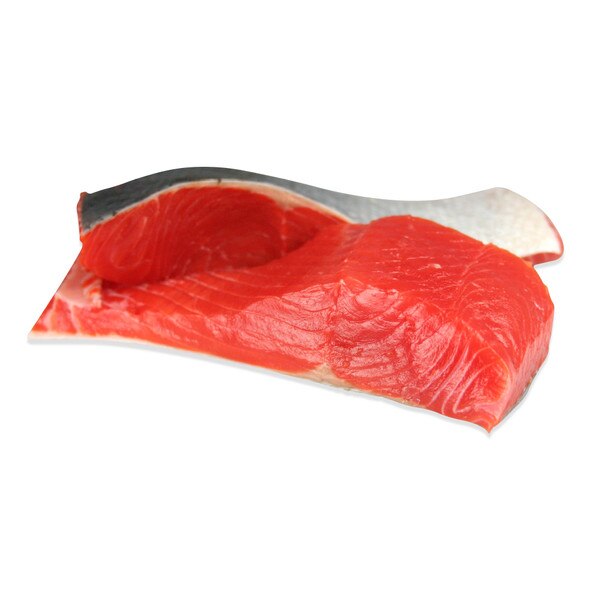
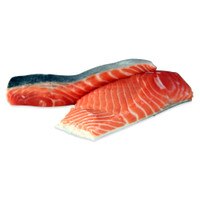
Wild Sockeye salmon has the reddest meat of all the salmon species. It also has relatively high oil content; in fact it has the 2nd highest oil content after King salmon. And like King salmon, it has a very rich flavor. Sockeye salmon has a medium flake size.
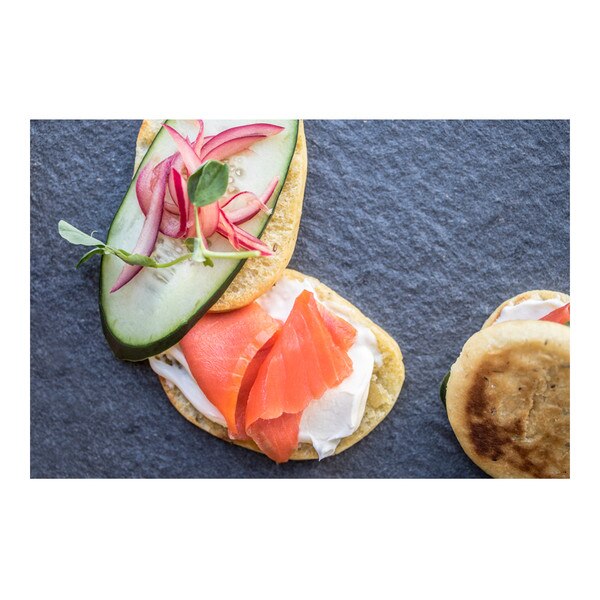
Applications: Salmon is a wonderful fish that can be prepared in an endless number of ways. It can be broiled, smoked, baked, fried, and grilled. It can also be served in salads, sandwiches, or in pasta.
Season: Sockeye season is typically May through September depending on the catch-area.
Origin: Typical catch areas of Wild Sockeye salmon are the coasts of Alaska, Canada, Washington, Oregon, California, Russia, and Japan waters, depending on the season. This year, however, the California and Oregon fisheries are closed.
Specifications: Our Wild Sockeye salmon fillets come individually wrapped and frozen with the skin on. Each fillet generally weighs 1-2lbs, and a case is approximately 10 lbs.
Shipping Method: Fedex Overnight Browse other Wild Caught Fish, Wild Caught Shellfish and Live Oysters.
|
|
Pan Seared Wild Salmon with Potato Hash and Asparagus
Recipe created by: Jeff Wampler
4 six-once wild salmon filets, bone-out and skin-on
1 bunch medium red or yellow beets with green tops attached
2 medium size leeks
1 pound small yukon gold creamers
4 pieces good-quality bacon
1 bunch asparagus
1 small shallot
2 T heavy cream
1 T unsalted butter
salt and pepper
Optional: 1/2 cup dry white wine
Preheat oven to 375 degrees
1. Roast the beets. Remove the greens on top of beets. Discard any greens that do not look fresh, wash the rest and set aside. Rinse the beets and scrub off any dirt before patting them dry and placing them in a glass pyrex casserole dish. Rub the beat with a little olive oil and season generously with salt. Add 1/2 cup of very hot water to baking dish and quickly cover with aluminum foil. Place in the middle of the preheated oven and bake for 50 minutes. Using a wooden skewer or small knife check that the beets are done and allow to cool for 5 minutes. When the beets are still hot peel the skin and cut each beat into about 8 pieces.
2. Parboil the Potatoes. I great technique for preparing potatoes for a hash is to first parboil them first. Clean the potatoes by scrubbing them under running water and then place in a medium size pot, cover with water, and bring to a boil over high heat. When the water comes to a rolling boil lower the heat slightly and keep a close eye on the potatoes. It is crucial that they are not cooked all the way but rather that they are al dente and have some resistance when pierced with a knife. Strain potatoes and allow to cool by spreading out on a baking sheet. If you think you have cooked them a little too long then quickly put the baking sheet in the fridge to help the them cool down faster. When the potatoes have cooled completely, cut each one into a large dice and set aside.
3. Caramelize the leeks. Cut off the dark green part of the leeks and discard or compost. Dice the leeks into thin 1/4″ pieces and place in a large bowl of cold water. Shake the leeks to wash off the dirt and then strain through a colander and allow to drip dry. Over very low heat melt the butter with 1 T olive oil and add the leeks when the butter is almost completely melted. Keep the heat very low and cook the leeks for about 30 minutes, stirring about every 5 minutes. When finished they should be just browned and very soft. Set aside.
4. Cook the Salmon. If you turned off the over after roasting the beets make sure it is preheated again to 375 degrees. Season both sides of the salmon fillets with salt and black pepper. Heat about 1 T olive oil in a sauté pan over high heat until the oil is smoking steadily. Carefully place the fillets skin side up in the pan and sear for roughly a minute and a half. The idea is not to disturb the fillets as they sear so that they develop a nice brown crush. Flip the fillets over to the skin side and continue cooking for another 30 seconds. At this point the salmon is ready to be finished in the over and if you want add the 1/2 cup of white wine to the pan before it goes into the oven. The wine will help keep the fish moist as it roasts. The time in the over entirely depends on how you like your salmon and the thickness of the fillet. If the fillet is of average thickness and you want medium go for about 6 to 7 minutes in the oven.
5. Finishing. Finish the salmon go into the oven, heat 1 T olive oil in a large sauté pan over high heat. When the oil is starting to smoke add the parboiled potatoes and stir frequently to prevent sticking. When the potatoes have browned add the roasted beets, caramelized leeks, and heavy cream. Continue cooking until the cream has evaporated- about 30 seconds.
|